As weather models confirm the onset of the 2026/2027 El Niño pattern across Southern Africa, rural communities, agricultural operators, residential estates, and mining operations are scrambling to secure backup water sources. For many, the default reaction to impending surface water scarcity is simple: drill another borehole or run existing pumps harder.
However, relying solely on direct underground water abstraction during a prolonged drought is one of the most dangerous operational missteps a property or utility manager can make.
When regional rainfall drops, groundwater recharge slows dramatically while local extraction surges. This combination causes water tables to plummet, resulting in burnt-out submersible pumps, severe water quality degradation, and sudden, total borehole failure precisely when water is needed most.
Key Takeaway: A borehole is an access point, not an infinite reservoir. During a drought, continuous high-volume pumping strips the aquifer faster than it can recharge. Pairing your borehole with a surface-level bulk storage buffer protects both your groundwater asset and your daily operations.
The Underground Reality: Why Boreholes Fail During El Niño
Groundwater is a vital strategic buffer against climate shocks, but aquifers are dynamic, finite systems. During an El Niño event, three major mechanics threaten unbuffered borehole infrastructure:
- Rapid Drawdown & Air Entrainment: As the static water level drops, continuous pumping creates a dynamic cone of depression around the borehole casing. Once the water level drops below the pump intake, the system pulls air, leading to cavitation, rapid motor overheating, and catastrophic pump failure.
- Declining Yields vs. Peak Daily Demand: An aquifer’s safe yield (the rate at which water can be safely extracted without depleting the water table) decreases during dry spells. Trying to pump at 100% capacity to meet instant daytime demand over-stresses the borehole, leading to mud, silt, and mineral drawing.
- Aquifer Salinization & Quality Drops: As deep water levels recede, lower-tier groundwater often exhibits higher total dissolved solids (TDS), salinity, and heavy mineral concentrations. Pumping directly into irrigation or domestic reticulation systems can damage crops, ruin plumbing, and compromise drinking safety.
                    DIRECT BOREHOLE PUMPING VS. BUFFERED STORAGE

  [ Direct Heavy Pumping (Risk) ]               [ Smart Overnight Buffer (Safe) ]

     Peak Day Consumption Surge                   Low, Steady Overnight Pumping
                  │                                             │
                  ▼                                             ▼
  ┌──────────────────────────────┐              ┌──────────────────────────────┐
  │ High Drawdown Cone           │              │ Borehole Recharges Safely    │
  │ Air Locks & Pump Overheating │              │ Zero Strain on Aquifer       │
  │ Mud / Sediment Intake        │              └──────────────┬───────────────┘
  └──────────────────────────────┘                             │
                                                               ▼
                                                ┌──────────────────────────────┐
                                                │ Modular Surface Reservoir    │
                                                │ (Instant Peak Water On Demand)│
                                                └──────────────────────────────┘
The Solution: Creating a Smart “Slow-Pump” Bulk Buffer System
To insulate your facility against borehole failure during El Niño, operations must decouple water extraction rate from instantaneous water demand.
Instead of forcing a pump to kick on and off at high flow rates whenever a valve opens during the day, install a large-capacity surface reservoir to act as an operational buffer.
1. Slow, Sustainable Overnight Pumping
A modular surface tank allows you to extract water from your borehole at a low, gentle flow rate over a 12-to-18-hour window (typically overnight when ambient temperatures are cooler and groundwater levels stabilize). This slow abstraction respects the aquifer’s reduced safe yield, preventing dynamic drawdown while ensuring the pump operates in its peak efficiency curve.
2. High-Volume Gravity or Booster Delivery
When peak daytime demand hits—whether for livestock watering, crop fertigation shifts, or residential estate morning rushes—water is drawn directly from the surface-level bulk reservoir, not the ground. The tank supplies high-volume flow via low-cost surface pumps or gravity feed, completely isolating the borehole from instantaneous consumption spikes.
3. Settlement and Quality Stabilization
Pumping groundwater into a closed, lined surface tank gives suspended silts, sand, and heavy minerals time to settle out before the water enters your main distribution network. This extends the lifespan of downstream filtration systems, drip emitters, and booster pumps.
Comparison: Direct Borehole Abstraction vs. Surface Buffer System
| Operational Factor | Direct Pumping from Borehole | Borehole + Sectional Steel Reservoir |
| Pump Stress & Life | High (Frequent cycling, air locks, thermal stress) | Very Low (Continuous, low-RPM overnight runs) |
| Aquifer Health | Stressed (Deep drawdown cones, risk of dry-running) | Protected (Stays within long-term sustainable yield) |
| Peak Flow Capacity | Limited strictly to instantaneous borehole yield | Virtually Unlimited (Dependent only on stored volume) |
| Drought Resilience | Failure risk increases as water tables drop | High (Multi-day emergency reserve stored above ground) |
| Water Settling | Grit and sand go directly to pipes/irrigation | Sediment settles at tank base away from outlets |
Engineering Your Surface Reserve with Modular Sectional Steel
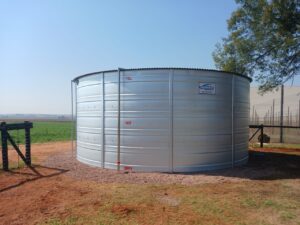
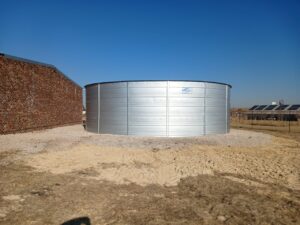
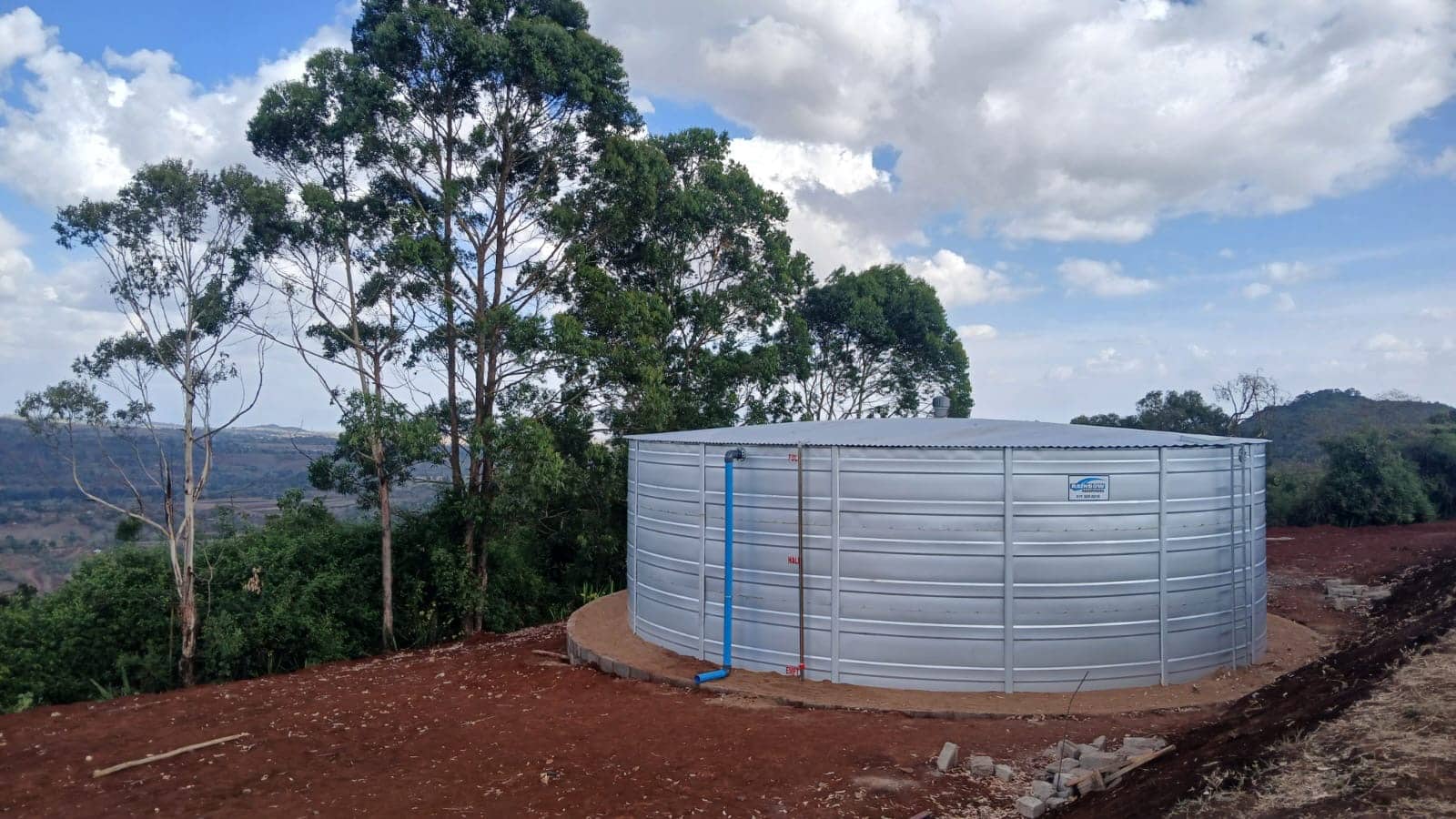
For rural installations, housing schemes, and mining camps, installing large-capacity surface reservoirs traditionally meant costly, permanent concrete construction. Modern modular sectional steel reservoirs provide a faster, more adaptable alternative:
- Capacity Sizing for Multi-Day Resilience: Sectional tanks can be built from 50,000 liters up to multi-million-liter capacities. Sizing your tank to store a 3-to-7-day reserve ensures your site remains fully operational even if a borehole requires temporary pump maintenance or yield recovery time.
- Corrosion Resistance & Water Hygiene: High-grade panel tanks constructed from anti-corrosive Aluzinc® steel reflect solar heat, keeping stored groundwater cooler. Combined with heavy-duty RPVC 1000gsm food-grade liners, the water remains clean, odorless, and protected from algae bloom or external contamination.
- Flexible Footprint & Remote Installation: Sectional steel panels are flat-packed for easy transport across rugged terrain. Units under 350,000 liters do not require concrete ring beams or slabs, meaning they can be erected rapidly on compacted bases in remote areas without heavy machinery.
Action Plan: Protect Your Groundwater Assets Before the Heat Hits
- Conduct an Up-to-Date Yield & Drawdown Test: Measure your borehole’s static water level, pumping water level, and recovery rate under dry-season conditions to establish its true safe yield.
- Calculate Peak Daily Volumetric Demand: Determine the total cubic meters of water your site consumes during a 24-hour cycle at peak summer temperatures.
- Install Surface Storage Capacity: Calculate the gap between instantaneous demand and safe hourly pumping rates, then install a modular sectional steel tank to bridge the buffer zone.
Don’t wait for your borehole pump to run dry.
Rainbow Reservoirs manufactures and installs rugged, long-life Aluzinc® sectional steel water tanks designed to protect groundwater infrastructure across Africa.Get a custom bulk water storage quote today.