As meteorologists confirm the approaching El Niño pattern, commercial warehouse operators, plant managers, and safety officers across Southern Africa are preparing for heightened operational risks. While severe agricultural droughts dominate headlines, industrial facilities face an equally critical threat: catastrophic fire risk coupled with municipal supply failure.
Prolonged heatwaves, extremely low humidity, and dry wind conditions create prime environments for both runaway veld fires and high-temperature industrial blazes. Compounding this danger, increased regional water demand often forces municipalities to throttle water pressures or implement rotational supply shutdowns.
If a blaze breaks out when municipal lines are low or dry, automatic sprinkler networks fail. For facility managers and insurance compliance leads, securing a dedicated, ASIB-approved fire water supply is not just good practice—it is an absolute operational and legal requirement.
Key Takeaway: Under the Automatic Sprinkler Inspection Bureau (ASIB) 11th and 12th Edition Rules, a fire suppression network must have a guaranteed, un-interrupted water reserve. Relying on municipal mains during a drought voids compliance and exposes your facility to total insurance repudiation.
The Dual Danger: High Fire Loads & Low Municipal Line Pressure
During dry seasons, the gap between a minor spark and a devastating structure fire shrinks dramatically. Industrial sites face three primary compounding risks:
- Veld Fire Contagion: Surrounding grass and bush fires spread rapidly across property perimeters, placing external structures, gas yards, and logistics bays under direct heat stress.
- Municipal Pressure Drop: High summer water consumption causes municipal mains pressure to drop below the threshold required to charge overhead sprinkler heads or feed high-volume fire hose reels.
- Pump Cavitation & Air Locks: When pumps draw from low-pressure or fluctuating municipal feeds, air enters the suction lines. This leads to pump cavitation—a mechanical failure that can destroy a fire pump within seconds of activation.
                  THE EL NIÑO FIRE PROTECTION COLLAPSE

  [ Extreme Heat & Low Humidity ] ──► [ Elevated Fire Risk ]
                                            │
                                            ▼
  [ Municipal Mains Throttling ] ──► [ Low System Pressure ]
                                            │
                                            ├─► Sprinkler Head Failure
                                            ├─► Pump Cavitation & Lockup
                                            └─► Insurance Claim Denial
Why Standard Water Tanks Fail ASIB & SANS 10400-T Audits
Not all water storage solutions meet the strict engineering benchmarks enforced by ASIB or the SANS 10400-T national building regulations. Off-the-shelf plastic water tanks or unlined storage structures carry major compliance hurdles:
- Capacity & Structural Integrity Limits: Fire systems demand massive water delivery rates (often hundreds of thousands of liters over a sustained discharge window). Standard poly tanks lack the volume capacity and structural engineering required for heavy industrial fire suppression.
- Lack of Anti-Vortex Protection: ASIB rules mandate specialized vortex inhibitors on tank suction outlets. Without a vortex inhibitor, fast-draining water creates a whirlpool effect that draws air directly into the fire pumps, causing immediate system failure.
- Risk of Accidental Depletion: Fire water must be strictly reserved for emergency suppression. Unregulated dual-use tanks without internal physical isolation run the risk of plant operators accidentally draining the fire reserve for routine industrial processes.
The Engineered Solution: ASIB-Approved Sectional Steel Tanks
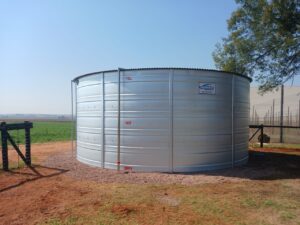
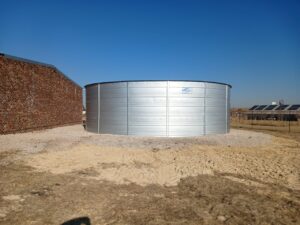
To ensure complete compliance and guaranteed operation during peak drought conditions, industrial property owners rely on engineered, sectional steel fire tanks.
           ASIB-COMPLIANT DUAL-RESERVE STEEL TANK DESIGN

  ┌─────────────────────────────────────────────────────────┐
  │                 Domed Anti-Evaporation Roof             │
  ├─────────────────────────────────────────────────────────┤
  │                                                         │
  │     [ Potable / Process Water Reserve ]                 │
  │     (Upper Draw-off Line for Daily Plant Use)          │
  │~~~~~~~~~~~~~~~~~~~~~~~~~~~~~~~~~~~~~~~~~~~~~~~~~~~~~~~~~│ ◄── Minimum Fire Line
  │                                                         │     Reserve Level
  │     [ Dedicated Fire Reserve ]                          │
  │     (Protected - Cannot Be Drawn by Daily Plant Use)    │
  │                                                         │
  └─────────────────────────┬───────────────────────────────┘
                            │
               [ Anti-Vortex Inhibitor Outlet ] ──► Fire Pumps
1. Dedicated Fire Reserves & Dual-Use Configuration
Modern sectional steel tanks can be engineered with dual-outlet configurations. The upper draw-off valve supplies daily process or potable water, while the lower outlet is dedicated exclusively to the fire sprinkler system. This ensures that even if daily factory operations use their full allocation, the primary fire suppression reserve remains 100% intact and untouched.
2. Heavy-Duty RPVC 1000gsm Food-Grade Liners
Corrosion, scale, and internal rust can flake off steel walls and block sprinkler nozzles during an emergency. Utilizing internal, heavy-duty RPVC 1000gsm liners prevents liquid contact with the outer structural steel, eliminating internal corrosion and ensuring clean, debris-free water delivery under high pressure.
3. Rapid Assembly & Compact Footprint
Sectional Aluzinc® steel panel tanks are flat-packed and assembled on-site. Tanks under 350,000 liters can often be erected on specialized compacted bases without requiring complex, time-consuming concrete foundation work—enabling quick deployment before the dry season reaches its peak.
4. Full Hardware Compliance Integration
A compliant installation includes essential ASIB hardware out of the box:
- Vortex Inhibitors: Engineered to maintain maximum pump suction without air entrainment.
- Levitator Gauges: Providing clear, ground-level visual verification of stored volume for safety inspectors.
- Lockable Access & External Safety Ladders: Facilitating mandatory annual SANS 1475 maintenance checks safely.
Compliance Checklist: Is Your Site Fire-Ready?
| Compliance Element | Standard Plastic/Poly Tanks | ASIB-Engineered Aluzinc® Steel Tank |
| ASIB 11th/12th Edition Certification | Rarely approved for high-hazard commercial sites | Fully certified for automatic sprinkler networks |
| Vortex Inhibitor Integration | Not standard / Retrofit required | Custom-fitted to pump discharge specifications |
| Fire Reserve Protection | High risk of accidental depletion | Guaranteed via physical outlet positioning |
| Evaporation & Thermal Protection | High UV degradation & water heating | Solar-reflective steel with domed roof covers |
| Max Capacity Limits | Typically capped under 20,000L per unit | Expandable modular capacities up to 4,000,000L+ |
Secure Your Fire Compliance Clearance Before Dry Season Hits
Waiting for an insurance audit—or worse, a fire emergency during an El Niño heatwave—is a risk no business can afford. Retrofitting non-compliant systems after a failed ASIB inspection can cost up to 500% more than installing an approved system from the start.
- Audit Your Fire Water Reserve: Verify if your current stored volume matches your building’s occupancy risk class and sprinkler flow duration under ASIB guidelines.
- Inspect Suction Line Hardware: Ensure your pumps are fitted with certified anti-vortex outlets and clear level indicators.
- Upgrade to Certified Bulk Storage: Partner with an established, certified tank manufacturer to install an ASIB-compliant fire protection reservoir.
Is your site fully compliant for the upcoming dry season?
Rainbow Reservoirs manufactures and installs ASIB-approved Aluzinc® sectional steel fire tanks across Africa. Protect your property, satisfy your insurer, and secure your operations.Request an ASIB fire tank quote today.