Imagine this: A fire breaks out in your commercial warehouse. Your automated sprinkler system activates, but within minutes, the water pressure drops to zero. The municipal grid has failed, your storage tank runs dry, and the building suffers a total loss.
Worse yet? Your insurer denies the multi-million rand claim because your water storage system failed to meet regulatory standards.
In South Africa’s commercial and industrial sectors, fire protection is more than a safety measure—it is a legal and financial cornerstone. If you are responsible for safeguarding a manufacturing hub, a shopping center, a mining site, or a large warehouse, compliance with the Automatic Sprinkler Inspection Bureau (ASIB) is your absolute first line of defense.
Here is what you need to know about securing your assets with ASIB-listed and approved fire water storage.
Why ASIB Compliance Isn’t Optional
The ASIB sets out strict regulations (governed by the 12th Edition Rules) to ensure that fire protection systems perform flawlessly under normal fire conditions. For large-scale properties falling under SANS 10400-T fire protection regulations, utilizing an uncertified water storage system carries massive implications:
- Insurance Peace of Mind: Most commercial insurers in South Africa will not provide full fire cover—or may outright reject a claim—if your system lacks a valid ASIB Clearance Certificate.
- Legal Liability: Under the Occupational Health and Safety (OHS) Act, employers are legally obligated to provide a safe working environment. Non-compliant infrastructure can result in severe legal liabilities if a system fails.
- Operational Continuity: A fire that isn’t suppressed in its “incipient stage” (the first few minutes) usually leads to catastrophic structural failure. Dedicated, compliant storage guarantees independent water availability even if the municipal water grid is down.
The Anatomy of an ASIB-Approved Modular Steel Tank
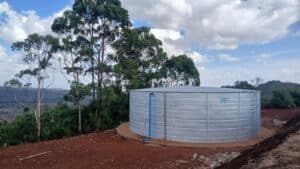
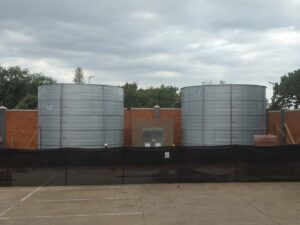
Unlike standard water reservoirs, an engineered fire protection tank integrates a highly specific ecosystem of components to maintain continuous, high-volume flow rates:
- Dedicated Fire Reserve: Engineering guidelines require that fire water storage remains isolated or safeguarded from domestic/process water usage so the tank is never accidentally drawn down.
- Vortex Inhibitors: Installed directly onto the outlet pipe, these prevent air from being drawn into the pump or gravity-fed system, eliminating severe pressure drops during high-velocity extraction.
- Robust Thermal & Corrosion Resistance: Utilizing premium high-tensile structural steel coated with an aluminum-zinc alloy provides the necessary heat reflectivity and a maintenance-free lifespan of up to 40 years.
- Heavy-Duty Internal Liners: 1000gsm specialized internal bladder liners isolate the liquid from the steel entirely, preventing internal rust, seepage, and structural degradation.
- Critical Access Compliance: Systems must feature levitator gauges for instant ground-level inspection, specialized safety ladders/platforms for annual audits, and lockable inspection hatches to prevent tampering.
Why Modern Industry is Moving Away from Concrete
Traditional concrete reservoirs used to be the default, but modular steel tanks have completely shifted the paradigm for industrial property managers in 2026:
When evaluating industrial water storage infrastructure, modular steel tanks offer several distinct operational advantages over traditional concrete reservoirs. In terms of construction efficiency, modular steel tanks can be assembled in a matter of days due to their flat-packed, bolted-panel design, whereas concrete structures require weeks or even months to account for extensive pouring and curing times. Maintenance overhead is further minimized with modular steel because they feature easily replaceable internal liners that completely isolate the liquid, while concrete remains highly susceptible to structural cracking, shifting, and subsequent seepage over time. Finally, modular steel tanks provide unparalleled operational flexibility, as the entire structure remains fully scalable and relocatable to adapt to changing site layouts, whereas a concrete reservoir is a permanent, immutable fixture.
Secure Your Infrastructure with Rainbow Reservoirs
When it comes to fire security, “close enough” is never enough. At Rainbow Reservoirs, we are a fully listed and approved ASIB supplier and a member of the Fire Protection Association of South Africa (FPASA).
We design, manufacture, and install modular steel liquid storage solutions ranging from 5,000 litres to over 4 million litres, tailored precisely to your property’s structural and flow rate requirements. Our competency-certified installation teams rapidly deploy units across the continent, keeping your facility compliant, your workforce safe, and your insurance completely secure.
Don’t wait for an audit—or an emergency—to find out if your system is compliant.
Let’s talk water security.
📞 +27 (0)11 965 6016