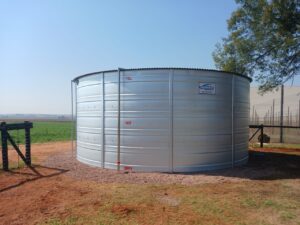
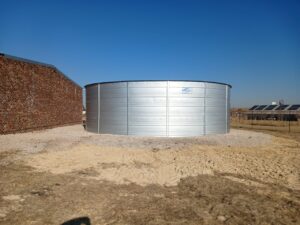
As South African water tariffs continue to climb and municipal reliability wavers, the sky is becoming a factory’s most undervalued asset. Large-scale industrial rainwater harvesting (RWH) is no longer just a “green” initiative—it is a sophisticated financial strategy to slash operational expenditure (OPEX) and secure a “free” primary water source.
But does the math truly add up for a massive Aluzinc® installation? Let’s break down the Return on Investment (ROI) and the long-term benefits of industrial-scale rain capture.
The Financial Drivers: Why Now?
Two factors are driving the surge in industrial RWH across South Africa:
- Rising Tariffs: Municipal water costs are increasing at rates well above inflation. For factories using millions of liters monthly, these costs can become a dominant line item.
- Tiered Pricing: Most municipalities charge more per kiloliter as consumption increases. By “skimming” your top-tier usage with rainwater, you keep your municipal bill in a lower, cheaper bracket.
The Cost-Benefit Breakdown
1. Capital Expenditure (CAPEX)
The initial investment includes gutter modifications, high-capacity filtration (first-flush diverters), and the storage reservoir. Using a Rainbow Reservoirs Aluzinc® tank significantly lowers CAPEX because:
- It requires less intensive civil works than concrete.
- The modular panels are cost-effective to transport and assemble.
2. Operational Savings (The “Payback”)
On average, a well-designed industrial RWH system can reduce municipal water reliance by 30% to 50%.
- Typical Payback Period: Most industrial systems in South Africa pay for themselves within 3 to 5 years.
- Post-Payback: After the initial investment is recovered, the water harvested is essentially free, providing a pure competitive advantage over rivals paying full municipal rates.
Technical Advantage: Aluzinc® for Rainwater Storage
Not all storage solutions are created equal. When harvesting rainwater, the quality of the storage vessel is paramount to the ROI.
- Purity Retention: Rainwater is naturally soft, but it can become “hard” or contaminated if stored in concrete (due to lime leaching). Our food-grade RPVC liners ensure the water stays at its harvested quality, making it ideal for cooling towers and boiler feed without causing scale build-up.
- Massive Volume Capacity: Rain falls in bursts. To maximize ROI, you need to capture as much as possible during a storm. Our “Mega Tanks” (up to 4 million liters) allow you to store enough water to bridge the gap during dry months, whereas smaller plastic tanks often overflow and “waste” potential savings.
A Case Study in Reliability
Imagine a 5,000 m² factory roof in a region receiving 600mm of rain annually.
- Potential Harvest: ~3 million liters of water per year.
- Value: At an average industrial rate of R45/kL, that’s R135,000 in annual savings.
- Secondary Benefit: During a municipal outage, that stored water prevents a factory shutdown that could cost millions in lost labor and broken contracts.
Conclusion: Future-Proofing Your Balance Sheet
Industrial rainwater harvesting is a rare “win-win.” It fulfills Corporate Social Responsibility (CSR) goals by reducing the strain on South Africa’s dams while simultaneously increasing the bottom line. With an Aluzinc® reservoir’s 40-year lifespan, the system will continue to generate “free” water long after the initial investment has been forgotten.