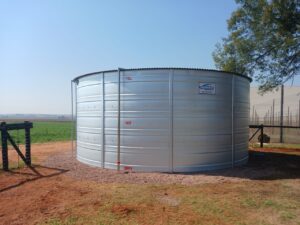
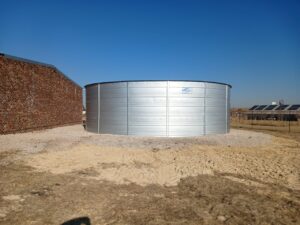
In the industrial sector, water is more than just a resource—it is the lifeblood of production. When choosing a bulk storage solution, many factory owners in South Africa face a classic dilemma: Aluzinc® vs concrete reservoirs. While concrete has been a traditional go-to for decades, the hidden long-term maintenance costs are causing a significant shift toward modular Aluzinc® steel tanks.
For a factory, the “cheapest” tank isn’t the one with the lowest price tag today; it’s the one with the lowest Total Cost of Ownership (TCO) over the next 40 years.
The Hidden Costs of Concrete Reservoirs
At first glance, concrete appears indestructible. However, for industrial applications, concrete reservoirs come with several high-cost liabilities:
- Structural Cracking: South Africa’s fluctuating temperatures and soil movements lead to “thermal fatigue.” Concrete is rigid, meaning ground shifts often result in hairline cracks that lead to catastrophic leaks.
- Porosity and Contamination: Concrete is a porous material. Over time, it can absorb chemicals or promote the growth of algae and bacteria within the walls, necessitating expensive high-pressure cleaning and chemical treatments.
- Waterproofing Failures: Concrete requires specialized internal waterproofing or “bituminous” coatings. These coatings degrade and must be stripped and reapplied every 5 to 10 years—a process that requires complete system downtime.
The Aluzinc® Advantage: Engineered for Zero Maintenance
Rainbow Reservoirs utilizes Aluzinc® steel, a specialized alloy of 55% Aluminum, 43.5% Zinc, and 1.5% Silicon. This material is specifically designed to eliminate the maintenance headaches associated with concrete.
1. Corrosion Resistance That Outlasts Galvanizing
Unlike standard galvanized steel, Aluzinc® provides a “self-healing” properties. If the surface is scratched during factory operations, the zinc sacrificial protection and the aluminum barrier prevent rust from spreading. This technology offers a lifespan of up to 40 years with virtually no exterior maintenance.
2. The Role of the RPVC Liner
In a Rainbow Reservoir, the water never actually touches the Aluzinc® shell. It is contained within a heavy-duty, food-grade RPVC liner.
- No Re-coating: Unlike concrete, you never need to “repaint” the inside.
- Easy Cleaning: The smooth surface of the liner prevents sediment buildup and algae attachment.
Financial Comparison: Upfront vs. Lifecycle Costs
| Cost Factor | Concrete Reservoirs | Rainbow Aluzinc® Tanks |
| Foundation Costs | High (Reinforced slabs required) | Low (Sand-bed base for <350kL) |
| Installation Time | 4–8 Weeks (Curing time) | 1–2 Weeks (Modular assembly) |
| Maintenance | High (Cracks/Sealing/Cleaning) | Near Zero (Liner protection) |
| Relocatability | Zero (Permanent fixture) | High (Bolted panels can move) |
| Lifespan | 20–50 years (with repairs) | 40+ years (guaranteed) |
Why Factories are Switching to Modular Steel
For modern manufacturing plants, agility is key. A concrete tank is a “gravestone”—once it’s poured, it can never be moved. If your factory expands or the site layout changes, a concrete reservoir becomes a multi-million Rand obstacle.
In contrast, Rainbow Reservoirs’ bolted-panel design allows the tank to be dismantled and relocated. Furthermore, because these tanks can be installed on a simple sand-bed foundation (for capacities under 350,000 liters), the “civil works” portion of your budget is slashed by up to 60%.
Conclusion: Protecting Your Capex
When you factor in the cost of water loss through concrete seepage and the recurring expense of structural repairs, Aluzinc® steel tanks emerge as the superior financial choice for South African industry. You aren’t just buying a tank; you are eliminating a future maintenance line item from your balance sheet.